

The Alphabet
This Kryptonian writing system is logo-alphabetic — it is comprised of a combination of alphabetic characters (where symbols represent sounds) and logographic characters (where symbols represent meaning). The alphabetic characters are used to write the majority of the language, while the logographs are relegated almost exclusively to the bound morphology of the language, e.g. verb conjugation, pronouns, particles.
"Kryptonese" Transliteration
To make things easier, there is a standardized transcription method for representing Kryptonian using the Roman alphabet, which in the context of Doyle Kryptonian, I call “Kryptonese” much the way Chinese uses “Pinyin” or Japanese uses “Romaji.” Throughout this site, Kryptonese will be written between forward-slashes, // to distinguish it from English text.
- Kryptonian: cas
- Kryptonese: /chahs/
- English: table
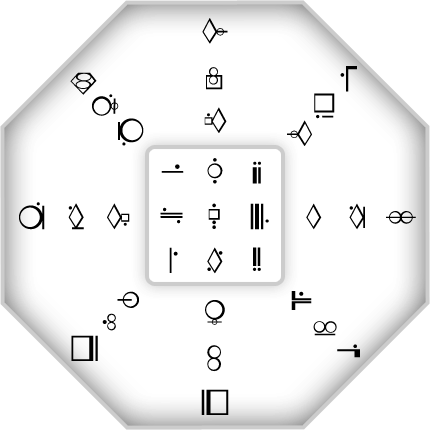
The Base Alphabet
The basic 33-letter alphabet is comprised of 24 consonants and 9 vowels. When written, the consonants are arranged into 8 “rays” arranged around the “hub” which contains 3 columns of vowels for a total of 11 lines. The arrangement of the letters within each “spoke” on this “wheel” is also meaningful. Each letter has its “mate” on the opposite side of the wheel. The top three spokes are all voiceless consonants with each finding their voiced counterpart in the opposing position in the bottom three spokes. For the horizontal spokes you have the nasal pairs (inner), rhotic pairs (center), and the remaining liquid/glide pair (outer).
The alphabet’s arrangement into 11 lines of 3 letters each is an intentional, pedagogical technique used to allude to the 11 Kryptonian virtues (the Girod). This arrangement is very similar to the arrangement of the Kryptonian flag, and the two were, in fact, made at nearly the same time and intended to evoke one another.
There is another pedagogical reason for the arrangement of the vowels into the grid formation — it forms the basis of several linguistic features like noun gender and verb conjugation.
Base Letter Names and Pronunciation
Just as with pretty much any alphabet you’d find on Earth, the Kryptonian letters all have names. Here is the basic alphabet in the most common listed form (although different list arrangements do exist).
The listing shows (in order):
- The Kryptonian character
- The pronunciation (IPA)
- The letter’s name (in Kryptonese)
- The Kryptonese transliteration
- The keyboard mapping
What is IPA? IPA (International Phonetic Alphabet) is an internationally standardized alphabet used to write speech with a one-to-one correspondence between sound and character. For example, [kʰɑə], [kʰɑɹ], [kʰɑɾ], [kʰaː], [kaɽ], etc. are all valid dialectically distinct pronunciations of the word “car.”
Usage: Common practice, observed throughout this site, is to place IPA between square brackets “[]” to distinguish it from normal writing.
Resources:
- There are several great resources online for learning IPA. A good place to start is the Wikipedia page on IPA.
- Another excellent resource can be found on the Paul Meier Dialect Services website which contains interactive IPA charts (click a symbol to hear the sound) — they even have an interactive diphthong chart with both American and British English diphthongs.
The 10th Vowel
In addition to the 9 vowels listed above, there is a 10th vowel that is treated somewhat as an alternate/raised version of e. In reality, this vowel acts independently as a full vowel in its own right — it isn’t an “alternate pronunciation” or anything like that. But in regards to noun Gender (see below), it sits in the same position as e.
Beyond the Basics: Vowels
Gendered Nouns
The Kryptonian language reflects natural gender in words through the use of its vowels. Please note that this gender is not word classification like you find in languages such as Spanish or German where all nouns carry a “gender”, but, rather, Kryptonian word gender only affects nouns that describe a living being that actually has (or implies, e.g. an android) a natural gender.
The gender of a gendered noun is determined by the first vowel of the word. The vowel may be “shifted” left or right on the vowel chart to change the gender of the word. For example, Ona /aonah/ (offspring) can become ina /inah/ (daughter) or una /unah/ (son). Dictionaries list gendered nouns in the neutral form with the gender-indicative vowel underlined.
Gendered Nouns and Politeness
Formal speech defers to the neutral gender whenever possible, while the gender-indicative forms are usually reserved for close personal or intimate speech. However, gender may be indicated in formal speech when it is needed for clarity — usually in 3rd person contexts or when speaking to more than one person. This formality applies in both directions in the social heirarchy, i.e., an underling would not use gendered speech with his superior nor vice versa.
The y vowel is considered to be a gender-neutral vowel, but should not be treated the same as the other vowels. y carries with it, not so much a sense of gender-neutrailty, as it does gender- all-inclusiveness. In gendered words, it is very uncommon (and less socially acceptable) to shift this vowel to a single-gendered entity (feminine: E or masculine: o).
This vowel can also be seen in some non-gendered words that may have carried gender in their original form, e.g., ZRyGRas /zrhygrhahs/ (city). This is evidenced by the fact that some of these words can be found in older texts, usually poetic in nature, in a gender-specific form, e.g., Kor-Fehn’s epic poem, ZRoGRas /zrhogrhahs/, universally translated as “City of Men.”
| Gender & Vowels | |||
|---|---|---|---|
| Feminine | Neutral | Masculine | |
| i | O | u | |
| E | e | y | o |
| A | U | a | |
Diphthongs
Kryptonian has three diphthongs. We have already encountered the first which is integrated into the base alphabet, but there are two others, a + i and o + i, which are written using ligatures.
Rhotic Vowels
Kryptonian has special characters for rhoticized vowels. In essence, these characters are somewhere in-between diacritics and ligatures made from the combination of a vowel + r /r/.
Note: there is no rhotic version of y /y/ which never occurs before r /r/.
| Rhotic Vowels | ||
|---|---|---|
ï [iɹ] /ir/ ï | Ö [a͡ʊɹ] /aor/ Ö | ü [uɹ] /ur/ ü |
Ë [eɹ] /er/ Ë | ë [ɛɹ] /ehr/ ë | ö [oɹ] /or/ ö |
Ä [æɹ] /er/ Ä | Ü [ɹ/ɹ̩] /r/ Ü | ä [ɑɹ] /ahr/ ä |
Syllabic R
You will also notice that the rhotic U /uh/ on the chart becomes r /uhr/ which is the same character for /r/. This is because, when preceding or following another consonant, /r/ is syllabic, and /uhr/ realizes as /r/. It is only when /r/ comes before a vowel that it loses its syllabic quality.
The Letter i and You
The letter i /i/ in Kryptonian, when preceding a vowel, loses its vowel quality to become the consonant [j] (as the “y” in English “you”). In this context, the letter is written as a diacritic above the following vowel. The combining can occur over any vowel including the rhotic vowels and the ligatures.
Note that í and Ý are exceedingly rare combinations in Kryptonian phonology.
Beyond the Basics: Consonants
Digraphs
Digraphs are two letters written together to represent one sound. English is full of these (e.g., th, sh, ch, etc.), but there are only two in Kryptonian. Note that spelling in Kryptonese transcription for both of these collapses to a shorthand.
- /zh + rr/ → /zrh/
- /gh + rr/ → /grh/
Prenasal Consonant
In Kryptonian, all of the voiced stops, affricates, and fricatives (the bottom three spokes of the written alphabet) can be pre-nasalized. In writing, this is indicated by preceding the consonant’s letter with the : character written in Kryptonese as /:/. This character has no pronunciation on its own, but coarticulates with the following consonant to create a syllabic nasal continuant. This is only found at the beginning of root morphemes.
Beyond the Basics: Logographs
In the Kryptonian writing developed by Val-Zho, ideographs were chosen to represent the majority of closed class words and morphemes.
The free-morpheme logographs and ideographs, such as the symbol Ş meaning “hope,” are almost all holdovers from older languages and orthographies which were rendered obsolete by Val-Zho’s new language for the unified planetary government. As such, the records of the meanings of these symbols that survived the destruction of Krypton with Kal-El are far from exhaustive and sometimes contradictory. This is no doubt fueled by several factors like regional differences and dialects, semantic drift, and even historic and political pressures.
The idea of Kryptonian being a logographic writing system was introduced on Smallville, but even from the very beginning that concept was always blended with a true alphabet. Around the same time, the idea that the Kryptonian house symbols themselves had meaning fed into this mixed-modality concept.
This idea continued on, in a way, into Man of Steel which expanded on the inventory of house crests and then deeply tied the design of the writing system around the lines and the shape of the Ş symbol.
Don’t expect the letters/symbols that these characters are mapped to in the font to make too much sense. In some cases, they are mapped in a scheme, e.g., the verb tenses. In other cases, I just had to use whatever symbols hadn’t already been mapped.
Linguistics usually divides lexicons into two main categories: open and closed. The closed class represents a fixed, limited set of words into which new entries are rarely, if ever, introduced. These include “function words” like pronouns, adpositions, conjunctions, determiners, etc. The open class represents categories of words into which new entries are freely and frequently introduced. These include “content words” like nouns, verbs, adjectives, and adverbs.
Free Morphemes
Object / Complement Marker
Grammatic particle used to indicate the direct object, the patient, or the core complement to the verb.
Note: does not combine with the Agent Marker
Indirect Object Marker
Grammatic particle used to indicate the indirect object.
Active Relative Clause Marker
Grammatic particle used to indicate a relative clause. The immediately preceding noun acts as the subject of the relative clause.
Passive Relative Clause Marker
Grammatic particle used to indicate a relative clause. The immediately preceding noun acts as the object of the relative clause. Distinguished from /ton/ by context (within a sentence vs beginning of sentence)
Relative Clause Object / Complement Marker
Grammatic particle used to indicate the direct object / complement inside a relative clause.
Passive Sentence
Auxiliary verb used to indicate a passive sentence. Distinguished from /to/ by context (beginning of a sentence vs within a sentence).
Affirmative (Yes)
While this is the same logogram as the emphatic/obligatory verb prefix, it can be used on its own for the word “yes”.
Negative (No)
While this is the same logogram as the negative verb prefix, it can be used on its own for the word “no”.
Instrument Marker
Grammatic particle used to indicate the instrument, agent, or method of an action.
Note: does not combine with the Object Marker
Definite Article
The definite article: “the”. Kryptonian does not have an indefinite article.
The base pronunciation is listed here, but the vowel in the definite article harmonizes with the vowel in any plural/quantifier suffix attached to the related noun.
The definite article combines with pronouns to form alienable constructive possessives.
Possessed-First Genetive
There are several forms of possessives in Kryptonian. This particle is used in the possessed-first, alienable contruction: “possession [im] possessor,” e.g., “the table of Bob.”
Simple Conjunction
The simple conjunction (“and”) in Kryptonian is /chao/, which you will note is the name of the letter c. Rather than spell out the word, Kryptonians adopted this letter as an independent logogram.
Note: This conjunction is only used within a sentence. There is a separate set of conjunctions used to join sentences together.
Verb Mood Prefixes
Interrogative
Used to form a question. Always comes at the beginning of a sentence.
Note: This character is always written underneath the sentence-marker punctuation (see below).
“Did you go to the store?”
Potential
Marks possibility, capability, or permission (“can,” “may,” or “might” happen).
“You can go to the store.”
Cohortative
Marks a proposed or encouraged joint action by the speaker and the listener(s).
Example: “Let’s go to the store.”
Exhortative
Marks an urgent or strongly encouraged action to the addressee(s).
Example: “You should go to the store.”
Hypothetical / Subjunctive
Marks hypothetical situations, contrary to fact, wished for, or otherwise non-actual statements. Often found in if/then statements.
“I would go to the store, if you go with me.”
Conditional
Marks a consequence that depends on a specific condition being met. These are most often found with if/then statements. Combines with the imperative and prohibitive to form polite requests.
“I would go to the store, if you go with me.”
Emphatic / Obligatory / Intensifier
Marks an intenseness or emphasis on the verb. If directed towards a person, indicates an obligation or necessity.
Note: this cannot be combined with the prohibitive or polite prohibitive prefixes.
“You must go to the store.”
Negative
Marks the negation of the verb indicating that the action does not happen.
“I did not go to the store.”
Imperative
Marks a direct command, request, or instruction, directing the addressee to perform (or not perform) an action.
“Go to the store.”
Polite Imperative
The polite form of the imperative, indicating a request or desired action.
“Please go to the store.”
Prohibitive
Marks the negative of the imperative, used to forbid or prohibit an action.
“Don’t go to the store.”
Polite Prohibitive
The polie form of the prohibitive, indicating a request or desire not to perform an action.
“Please don’t go to the store.”
Verb Tense/Aspect Suffixes
Verb tense and aspect is indicated through suffixes. These suffixes are use and are aligned with the vowels on the vowel chart — another pedagogical reason to memorize the order layout of the vowel chart.
- Type 1 verbs in a sentence must take one of these suffixes.
- Type 2 verbs do not take these suffixes. Instead they are “irregular” with three unique forms carrying simple past/present/future aspects only.
- The bare form of the verb is used to form gerunds and infinitives.
- Example of a gerund: “I like swimming.”
- Example of an infinitive: “I want to swim.”
Habitual Aspect
Something done as a matter of routine, e.g., “I walk every day.” This is formed with its own infix, ä /ahr/, inserted between the bare stem and one of the progressive aspect suffixes — it cannot be used with the simple or perfect aspect suffixes. See the grammar page for examples.
| ASPECT | ||||
|---|---|---|---|---|
| Progressive | Perfect | Simple | ||
| TENSE | Future | ! [i] /i/ ! | @ [a͡ʊ] /ao/ @ | # [u] /u/ # |
| Present | $ [es] /es/ $ | % [ɛθ] /ehth/ % | ^ [oð] /odh/ ^ | |
| Past | & [æs] /as/ & | * [ʌʃ] /uhsh/ * | ( [ɑʒ] /ahzh/ ( | |
Pronouns
Almost all pronouns are gendered nouns. As you examine the pronoun chart alongside the vowel chart, you can see that the default form of each is neutral and the vowel can be shifted left or right to indicate feminine or masculine gender. Gendered forms of the pronouns are indicated with either one or two dots written below the logograph.
Again, this is indicative of actual, natural gender and is not a linguistic category.
Politeness and Gender
- Polite speech omits gender whenever possible/unnecessary. This translates to writing where the bare form of the pronoun logographs are gender-neutral.
- The first-person plural pronoun is almost never gendered, and will stand out as highly unusual in practice. It’s better to avoid using feminine/masculine “we” unless you have strong reasons to do so.
Personal / Animate / Inanimate
- PERSONAL: Used to refer to intelligent, sapient beings, e.g., Kryptonians, Humans, thinking robots/machines/AIs (like Braniac), etc.
- ANIMATE: Used to refer to non-sapient living creatures, e.g., animals, pets, plants, etc.
- INANIMATE: Used to refer to anything that falls outside of the above categories, e.g., objects, “dumb” robots/machines, etc. This pronoun is not gendered.
Quantity
- Neither of the first-person pronouns (I/we) can take the plural suffix (/o/).
- The first-person plural pronoun (we) can take quantitative suffixes.
- All other pronouns can take both plural and quantitative suffixes.
- Example: /zhehd/ (he/her) → /zhehdo/ (they).
| Feminine | Neuter | Masculine | |
|---|---|---|---|
| 1st-Person - Singular | <x [xæp] /khap/ <x | x [xʌp] /khuhp/ x | >x [xɑp] /khahp/ >x |
| 1st-Person - Plural | <X [kɹep] /kr/ <X | X [kɹɪp] /khuhp/ X | >X [kɹop] /khahp/ >X |
| 2nd-Person | <q [rip] /rrip/ <q | q [ra͡ʊp] /rraop/ q | >q [rup] /rrup/ >q |
| 3rd-Person - Personal | <C [ʒed] /zhed/ <C | C [ʒɛd] /zhehd/ C | >C [ʒod] /zhod/ >C |
| 3rd-Person - Animate | <F [ɣi] /ghi/ <F | F [ɣa͡ʊ] /ghao/ F | >F [ɣu] /ghu/ >F |
| 3rd-Person - Inanimate | L [gɛd] /gehd/ L |
Honorifics
With the exception of the generic honorific, /jran/, these honorifics indicate family relationship. They can be attached to names (Kal-El, Lara, Bob, etc.), relevant nouns (sister, brother, father, etc.), or 2nd/3rd-person and reflexive pronouns (he, they, mine).
These are added as suffixes, and always “attached” with the proper noun punctuation mark. Examples:
- ,kal,el,B /,kahl,ehl,cheh/ (“his/her/their” Kal-El)
- Ona,N /Onah,ni/ (your child)
Note: in Kryptonian, the effect of calling your cat “Mr. Whiskers” using a familial honorific rather than the generic one would be demeaning to you (or someone else). It lowers the person in connection to the level of the animal rather than raising the level of or anthropomorphising the pet.
Numbers
Kryptonian uses a base-10 numbering system, so at the basic level, writing numbers behaves pretty much like you would expect with some very important distinctions. It is interesting to note that the numbers 1 to 11 can all be written with a single character; this was almost certainly the intent to evoke the 11 virtues of the Girod.
Cardinal Numbers
What follows is a description of what you’ll see, but perhaps the best way to understand the writing is just to examine the examples here.
- Order of magnitude scales left-to-right (“little endian” for all you programmers). This is the opposite of our numbers that scale right-to-left (“big endian”).
- There is a single character that, by itself, represents the number zero: ≈
- Unlike our numbers, though, this character is never used as a placeholder. For example, you wouldn’t see this character in the number 1,000.
- This character is used, though, as the decimal point.
- At first it was believed that there was a special character for the number 10 º (and possibly 11 ¡), but now it is understood that these are variants of the character for 1 that behave more like language than math. Go figure.
- When this character is string-final (i.e., no more characters to the right of it), it implies a 1 in the final column. So, written by itself, it is the number 10 or 11.
- When there are numbers to the right of this character, the dot (previously thought to be just decorative) tells you whether this character represents 1 in its own column or is acting just as a column placeholder.
- The less-used zero/decimal character ≈ is mapped to ≈ in the font (option+x on a Mac).
- The 10 combining character 0 is mapped to the number 0 as it most often is used as the placeholder 0 in number strings.
- The 11 combining character ` is mapped to the grave (`) symbol (just to the left of the 1).
- There are non-combining string-final variants of both of these characters that feature a more prominent, decorative hook.
- The 10 variant º is mapped to º (option+0 on a Mac).
- THe 11 variant ¡ is mapped to ¡ (option+1 on a Mac).
Ordinal Numbers
To represent ordinal numbers (first, second, third, etc.), the numbers are written with an underline (except under the decimal character). You can type the ordinal variants of all of the numbers by typing an underscore after each digit.
Punctuation
Sentence Marker
Kryptonian sentences are marked at the beginning with this basic punctuation.
Paragraph Marker
In longer prose, sentences marking thematic or topic change are flagged with this modified form of the sentence marker. Similar to how English uses paragraph breaks to group content. This can also be used to draw attention to a particular sentence, akin to the exclamation point.
Connected Sentence Marker
When two sentences are joined together using a conjunction or similar construction, subsequent sentences start with this modified form of the sentence marker, similar to a comma. This can also be used to join semantically related sentences as a stylistic choice similar to a semicolon.
Questions
The interrogative verb prefix is technically not punctuation, but when present it is always first in a sentence, and is always written underneath the sentence mark, so it might appear to be punctuation the way that it is written. Just don’t forget that it is a spoken morpheme!
Proper Nouns
Proper nouns in Kryptonian are enclosed with this punctuation mark which also replaces internal spaces within a proper noun, e.g., ,kryptan, (Krypton) and ,jor,el, (Jor-El). This is also used to join any honorific markers to the end of a name/word, e.g., ,bin,M (Mr. Bean).
Quotation Marks
Quoted speech is enclosed with these right-angle punctuation marks — the lower left at the beginning, upper right at the end.